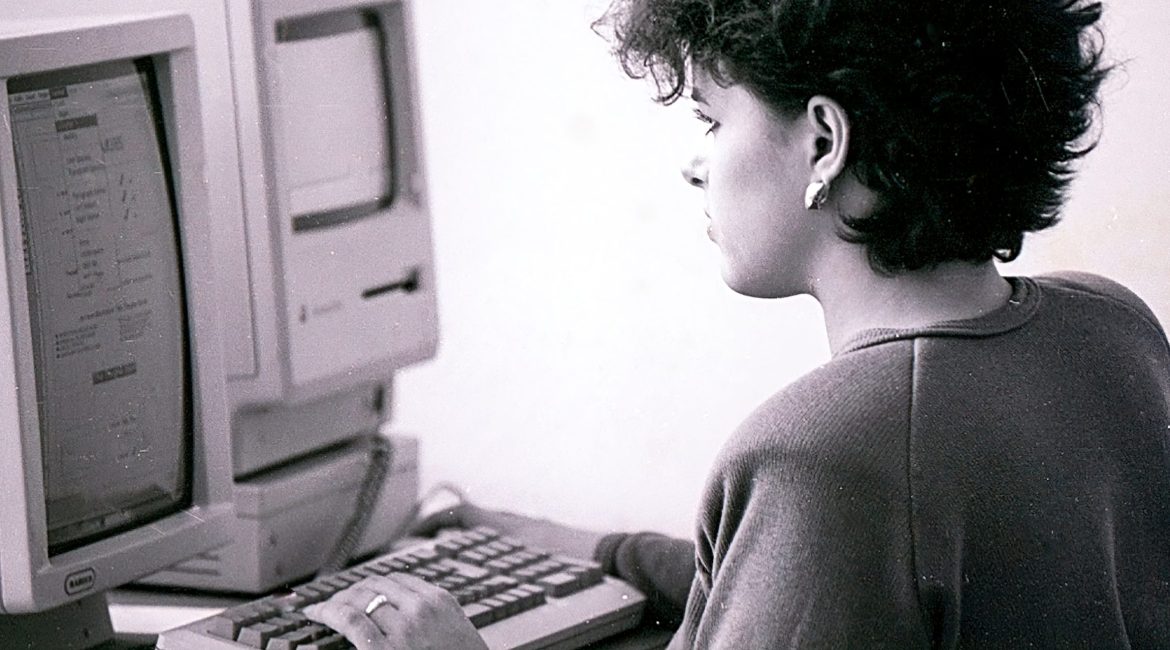
From a single sterilisation tracking system built for Gosford Hospital to a platform now trusted by more than 100 healthcare organisations across Australia and New Zealand, Precision Medical’s journey is one of adaptability and an unwavering commitment to patient safety.
Humble beginnings: the foundation of STS
The story began in 1998, under the name Precision Data, with a system built for Gosford Hospital where Precision Medical CEO, Jennifer Grainger, was the Operational Manager in the CSSD. They set out to solve a fundamental problem: bringing traceability to the sterilisation process at a time when most healthcare environments still ran on manual, paper-based workflows. This is when Sterile Tracking Solutions (STS) was born. Scanning, automation and system integration were only just emerging as ideas, as the very first formal sterilisation standards for Australia had been introduced.
STS was simple but forward-thinking. It generated barcode labels for instruments, allowed items to be scanned into steriliser loads, and recorded whether each load passed or was rejected. There was no link to patients, no full instrument lifecycle, and a great deal still depended on manual steps outside the steriliser. Even so, barcode-based tracking was a meaningful leap forward, and it laid the groundwork for something far larger.
STS was built to adapt to various coding languages. This made it technically robust but difficult to change and scale, and as hospitals began asking for more, it became clear the software would need to evolve quickly to keep up with client needs.
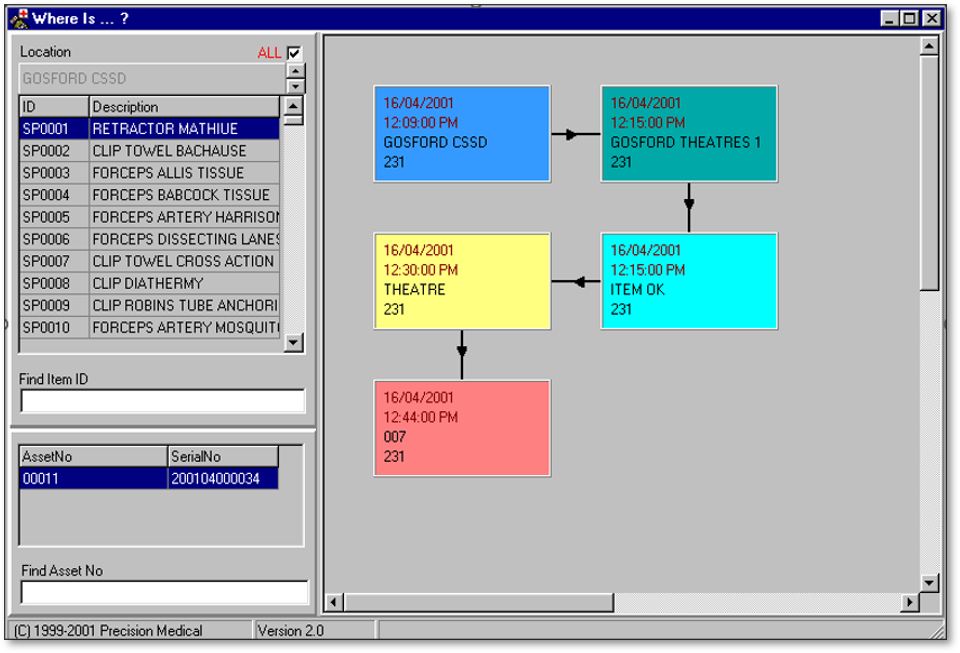
An early traceability view follows a single instrument – a Mathieu retractor – from the Gosford CSSD through theatre and back, time-stamped at every step. The principle it captured in 2001 still sits at the heart of MaQS today.
Early challenges, and a turning point
The early 2000s brought that change into focus. Y2K fears of losing valuable data, and around 2006 the sterilisation standards across Australia and New Zealand evolved, which raised the bar for compliance, traceability and accountability. STS had not been designed with these standards in mind, and substantial redevelopment was needed to meet them.
In addition to this, Precision Data was split and Precision Medical made its name. At this stage, Chris Wilson, the current Owner and Managing Director, bought into the business.
The MaQS era begins
A defining moment arrived in 2005, when Arthur de Lima joined as a software developer, and has remained with Precision Medical to this day. After a complete redesign, MaQS was created – the first true Precision Medical instrument tracking system.
The change was structural – generic asset tracking gave way to purpose-built models for trays, packs, instruments and inventory. The concept of templates was introduced and a cleaner, more flexible architecture made the system far easier to extend. It was a foundation the company could finally build on.
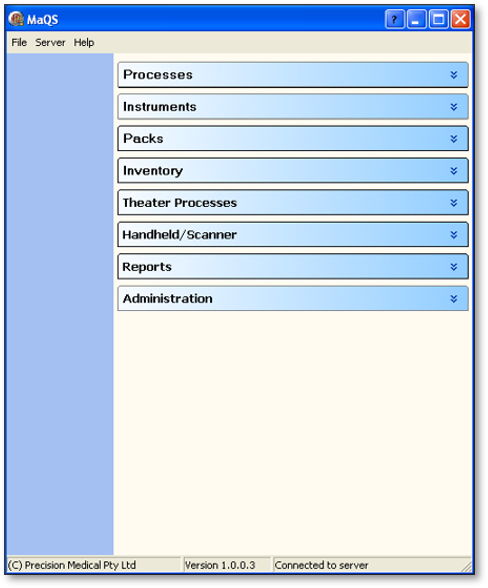
The first development of MaQS brings processes, instruments, packs, inventory, theatre, handheld scanning, reporting and administration together in one structured workspace.
Shortly after Arthur’s arrival Jennifer Grainger officially joined the Precision Medical Team, paving the way for clear strategic direction, and the company began to grow – onboarding new clients, expanding the team, and strengthening day-to-day operations under Jenny’s leadership.
From a single tool to a platform
As healthcare organisations embraced digital systems, Precision Medical kept finding and closing gaps in clinical workflows. What started as sterilisation tracking grew into the MaQS Software Suite, spanning instrument tracking; inventory management, including patient-linked consumables and implants; Loan Set Connect for managing loan instrument logistics; endoscopy tracking; and Central Asset Tracking.

A moment from the early days of MaQS: CEO Jennifer Grainger and first MaQS Developer Arthur de Lima laying the foundations for what would become Precision Medical’s innovative instrument tracking solution in 2008.
A new standard of trust
Precision Medical’s commitment to excellence reaches well beyond features and workflows. In 2016, the company achieved ISO 27001:2016 certification, an internationally recognised benchmark for information security management. They also attained this certification in 2026, highlighting their dedication to information security, data protection, and the trust and reliability that an increasingly digital healthcare landscape demands.
A philosophy of continuous improvement
Jennifer’s leadership and vision saw her rapidly progress through the organisation, leading to her appointment as CEO for Precision Medical. At its core, she drives a simple, consistent method: identify gaps in healthcare workflows, develop practical and targeted solutions, then continuously refine and expand them. Customer feedback, evolving standards and new technology all help shape what comes next.
“Looking back over the journey of MaQS, I feel incredibly fortunate to have been part of its story from its very conception.
Before joining Precision Medical, I worked as the Operational Manager of a Sterilising Services Department, where I experienced firsthand the challenges of managing compliance, quality, and the demands of delivering safe patient care. Those experiences shaped my understanding of what our customers truly need from their software—not simply a system that records information, but one that supports people in doing their jobs with confidence and efficiency.
When Chris Wilson acquired Precision Medical in 2005, I joined the company and have had the privilege of helping shape the ongoing development of MaQS. Over the years, technology has changed dramatically, healthcare has evolved, and customer expectations have continued to grow. Through every stage of that journey, one principle has remained constant: we develop MaQS by listening to our customers.
What began as a solution to meet the needs of a small number of hospitals has grown into a comprehensive, flexible, and scalable platform that supports healthcare organisations across Australia and New Zealand. Every enhancement, every new feature, and every improvement has been driven by the real-world experiences of the people who use our software every day.
While I am proud of what MaQS has become, I believe our greatest strength has always been our people. Behind every release is a dedicated team of developers, trainers, support specialists, and operational experts who genuinely care about our customers’ success. Their knowledge, professionalism, and commitment are what make Precision Medical the company it is today.
As CEO, it is a privilege to lead such an exceptional team and to continue building on the vision that began so many years ago. Although we are proud of our history, we remain focused on the future, continuing to innovate, embrace new technologies, and partner with our customers to meet the changing needs of healthcare.
Our story is one of continuous improvement, enduring partnerships, and a shared commitment to quality. I am excited to see where the next chapter takes us”.
— Jennifer, CEO, Precision Medical
Key Milestones
| Date | Milestone |
|---|---|
| 1998 | The Sterilising Tracking Solution (STS) is built for Gosford Hospital under Precision Data – bringing barcode traceability to sterilisation. |
| 2005 | Arthur & Jennifer join the company, and a re-architecture of the software commences. MaQS is officially released into the healthcare world. |
| 2009 | Introduction of MaQSPlus – an additional software suite that included advanced instrument data management. |
| 2013 | Inventory management arrives, including patient-linked consumables and implants – extending traceability well beyond the steriliser. |
| 2015 | HL7 integration established, enabling reliable patient validation and genuine interoperability with hospital systems. |
| 2016 | Achieved ISO 27001:2016 certification, for information security management, and ISO 9001:2015 certification, recognising excellence in quality management processes. |
| 2017 | Introduction of MaQS Dashboard and MaQS Repairs – further differentiating MaQS from other instrument tracking solutions through enhanced visibility, streamlined workflows, and improved asset management. |
| 2020 | Introduction of MaQS CAT (Central Asset Tracking) and MaQS Endoscopy Tracking Suite |
| 2021 | Delivered the successful onboarding of the Australian Defence Force (ADF), establishing a strong and trusted client partnership. |
| 2026 | Achieved ISO 27001:2022 certification for information security management. |
Looking ahead: MaQS v9.0 and beyond
With the release of MaQS v9.0 on the horizon, attention remains firmly on the future. Over the next five years, Precision Medical aims to deepen system integration, expand supplier connectivity, and continue aligning with evolving standards to build an increasingly connected and intelligent healthcare ecosystem.
From a simple barcode tracking system in 1998, to a comprehensive healthcare platform today, the throughline has been constant: innovation, adaptability and a commitment to better patient outcomes. By giving clinicians greater visibility across instruments, assets and inventory, Precision Medical continues to help healthcare organisations strengthen compliance, improve efficiency and deliver safer care across Australia, New Zealand, and the years to come.