
For CSSD managers and sterile supply professionals, securing approval for new systems like digital instrument tracking can be challenging. The problem is rarely the idea itself — it is how it is presented.
A well-constructed business case can be the difference between approval and being told it will be looked into later. The following outlines how to build one that decision-makers will take seriously.
What is a Business Case?
A business case is a document that outlines the benefits and costs of implementing a new product, service, or process change. In most health organisations, it is a concise 1-2 page document, structured around evidence.
The UK Treasury’s Green Book (2022) — a framework widely adopted across public sector organisations in Australia and New Zealand — states that business cases must be supported by robust data, options appraisal, and a clear case for change. A strong business case is clearly presented, data-driven, and considers more than one option.
Start With Options, Not a Decision
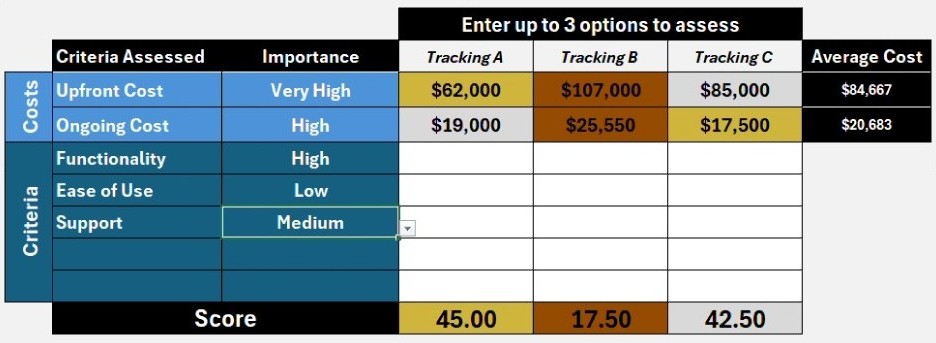
Before nominating a preferred product, compare a shortlist of alternatives. Assessing multiple options demonstrates objectivity and prevents the business case from appearing predetermined. Gather quotes from two or three vendors and evaluate them against a consistent set of criteria, such as:
- Functionality: Does it meet your compliance and operational requirements?
- Ease of use: Can your team adopt it with minimal disruption?
- Support: Is local support available when needed?
Weight each criterion by importance. If budget is a primary constraint, cost should carry more influence in the scoring. This approach — known as Multi-Criteria Decision Analysis — produces a defensible result that is straightforward to explain. Any vendor that fails to meet an essential requirement, such as a critical compliance feature, should be removed from consideration regardless of its overall score.
Quantifying the Benefits
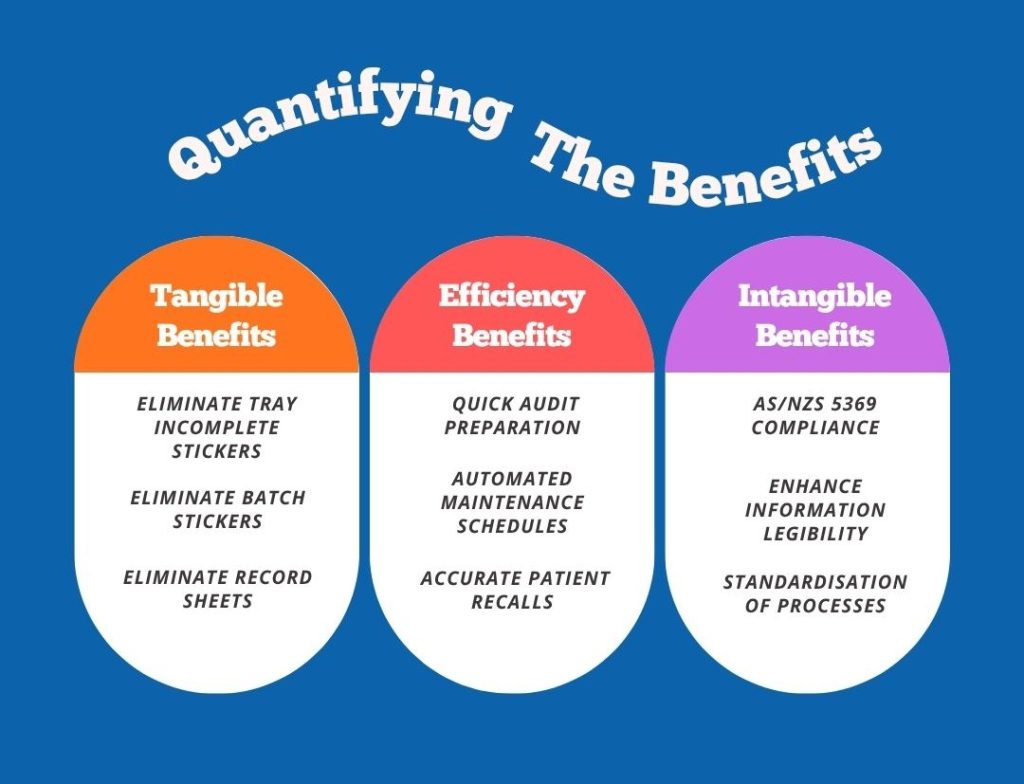
Once a preferred option is identified, benefits should be categorised as follows:
1. Tangible Benefits
These are direct, measurable cost savings. For a digital tracking system, examples include:
- Reduced consumables: Where the system reduces wastage or unnecessary reprocessing, savings can be calculated based on unit cost and annual volume.
- Environmental and utility savings: Reductions in water, power, or gas consumption carry both a cost and an environmental benefit.
2. Efficiency Benefits
These are time-based savings and require careful estimation. Calculate how long tasks currently take, how long they will take with the new system, and the annual frequency of each task.
Time saved does not automatically translate to cost saved. Rather than assuming staff reductions, consider more realistic pathways such as:
- Overtime reduction: Streamlined workflows may reduce the need for additional hours.
- Reduced agency staff reliance: Greater efficiency may lower the need for casual or agency cover.
- Natural staff attrition: Efficiency gains may reduce total staffing needs over time through natural turnover.
- Staff reallocation: Freed capacity can be directed to other critical areas of the organisation.
Estimating that approximately 50% of time savings will translate to cost savings is a realistic and credible approach. Transparency here strengthens, rather than weakens, the business case.
3. Intangible Benefits
Not all benefits are financial, but they remain significant. For a digital tracking system, intangible benefits commonly include improved instrument traceability, reduced risk of instrument failures or missing sets, stronger audit capability for accreditation, and faster response to recalls or incidents.
Where possible, assign each intangible benefit a likelihood and impact rating. Many health organisations align their risk frameworks to Ministry of Health guidelines, and structuring intangible benefits as risk reductions can position the business case directly within that context. A case that demonstrates meaningful quality improvements and risk reductions is still compelling, even if the financial return is modest.
Transparency: Assumptions and Exclusions
A credible business case acknowledges what is not yet known. Two tools help manage this clearly:
- Assumptions: Estimates accepted as reasonable where exact data is unavailable. For example: “We have assumed an average hourly staff rate of $40 and that 50% of time savings will be realised as cost savings.”
- Exclusions: Items not costed because sufficient information is not yet available. For example, internal procurement costs may be excluded pending a formal tender process.
Stating assumptions and exclusions explicitly demonstrates rigour and builds trust with decision-makers.
Document Structure
A complete business case for instrument tracking software typically includes the following sections:
INTRODUCTION
A brief statement of what is being proposed and why.
BENEFITS
Data-driven tables summarising tangible, efficiency, and intangible benefits are more effective than written descriptions alone.
IMPLEMENTATION PLAN
At the early stages, it is acceptable to note that a detailed implementation plan will be developed if there is approval to proceed.
ASSUMPTIONS
A summary of estimates and approximations made throughout the document.
EXCLUSIONS
A clear list of what has not been costed and the reason why.
RISKS
Known risks, and a risk register where applicable.
What a Strong Result Looks Like
A well-constructed business case for digital instrument tracking in a mid-sized CSSD department might demonstrate annual cost benefits of $80,000 — or $52,000 net after ongoing costs — alongside nine identified intangible quality and risk improvements. Presented clearly and concisely, this is a compelling case for any Director of Operations or General Manager to consider.
Final Thoughts
The purpose of a business case is to give decision-makers the confidence to approve a proposal. When it is grounded in honest data, fairly evaluates multiple options, and clearly articulates both financial and non-financial benefits, it is difficult to dismiss.
Precision Medical Australia has developed a free business case tool to assist CSSD managers in structuring and presenting their case. To request a FREE copy, complete the form here.